The Problem: Hitting the Database Wall
Picture this: Your application is a success. User growth is exponential, feature engagement is through the roof, and your investors are happy.
But your on-call engineers are miserable.
Your monitoring dashboards show CPU usage pegged at 95% on your primary database instance. Queries that used to take milliseconds are now timing out. You’ve already upgraded to the biggest AWS RDS instance available, and you’ve optimized every index. You have officially hit the wall of Vertical Scaling.
When a monolithic database can no longer handle the volume of writes or the size of the dataset, you have two choices: stop growing, or change your architecture.
It’s time to talk about Database Sharding.
Vertical vs. Horizontal Scaling
Before defining sharding, we must understand the two ways systems grow.
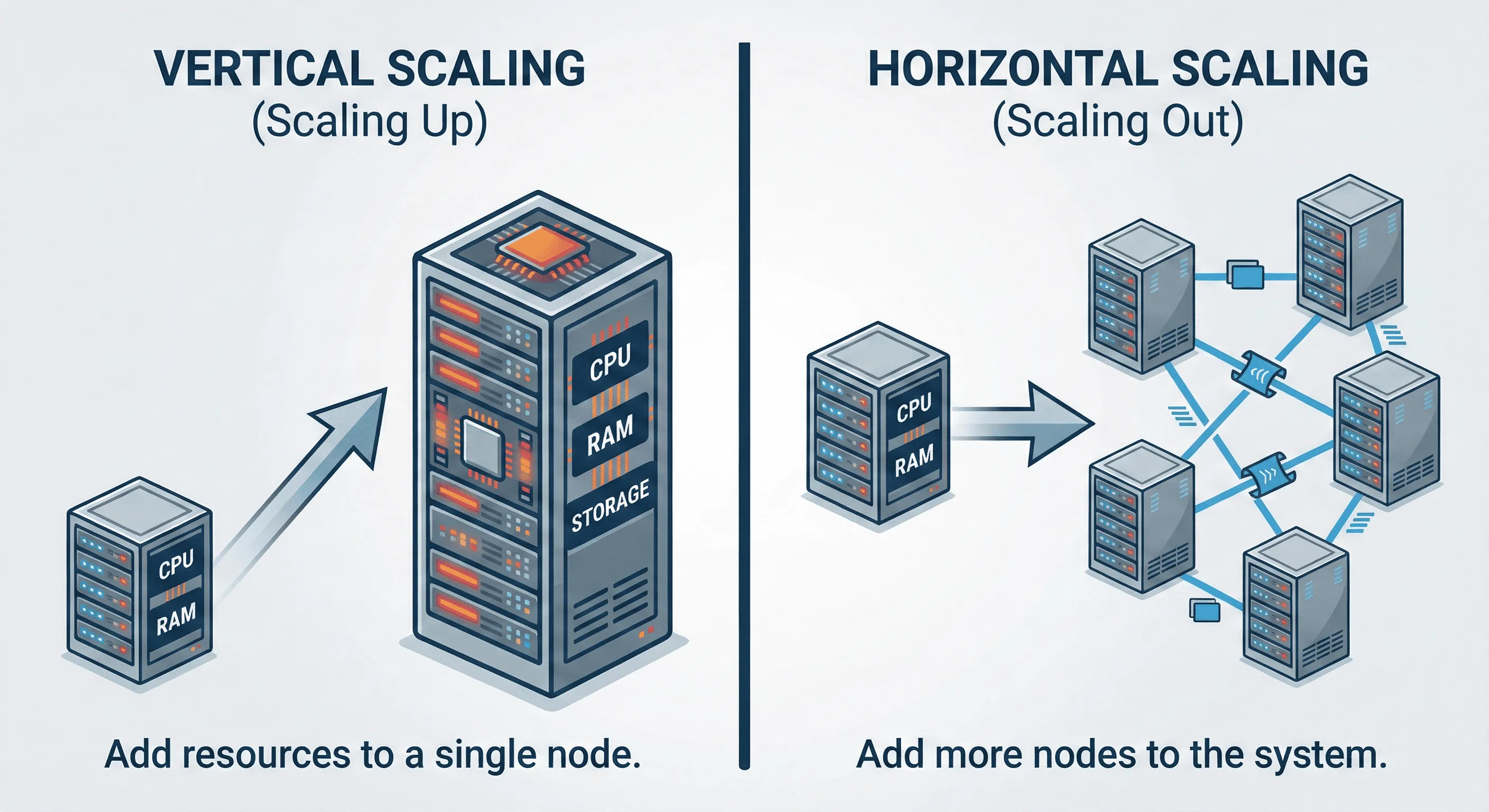
- Vertical Scaling (Scaling Up): Buying a bigger machine. More RAM, a faster CPU, bigger SSDs. It’s simple to implement but has a hard physical limit and gets exponentially expensive.
- Horizontal Scaling (Scaling Out): Adding more machines. Instead of one giant server, you use five smaller ones working together.
Traditional relational databases (like PostgreSQL or MySQL) were designed to run on a single machine. Sharding is the technique we use to force them to scale horizontally.
What is Database Sharding?
Database Sharding is a method of splitting a single dataset across multiple database instances.
In a sharded architecture, you don’t have one giant Users table containing 100 million rows on one server. Instead, you might have ten separate database servers, each holding a Users table with 10 million rows.
Each individual database instance is called a Shard. All the shards together make up your single logical database.
The Key takeaway: Sharding implies that the data is partitioned horizontally. You are splitting rows, not columns.
- Vertical Partitioning (Not Sharding): Moving different tables to different servers (e.g., User table on Server A, Products table on Server B).
- Horizontal Partitioning (Sharding): Moving rows of the same table to different servers (e.g., Users A-M on Server A, Users N-Z on Server B).
The Crucial Element: The Sharding Key
If your data is spread across ten servers, how does your application know which server to query when it needs to find “John Doe”?
You cannot query all ten servers simultaneously; that defeats the purpose of performance scaling. You need a map.
This map is determined by the Sharding Key (or Partition Key). This is a column (or set of columns) in your table used to determine which shard a specific row belongs to. Choosing the right sharding key is the single most important decision in this entire process.
A bad sharding key leads to unbalanced servers and operational nightmares.
Sharding Strategies
How do we use the key to assign data to a shard? There are three primary strategies.
1. Key-Based (Algorithmic/Hash) Sharding
This is the most common technique for ensuring data is evenly distributed.
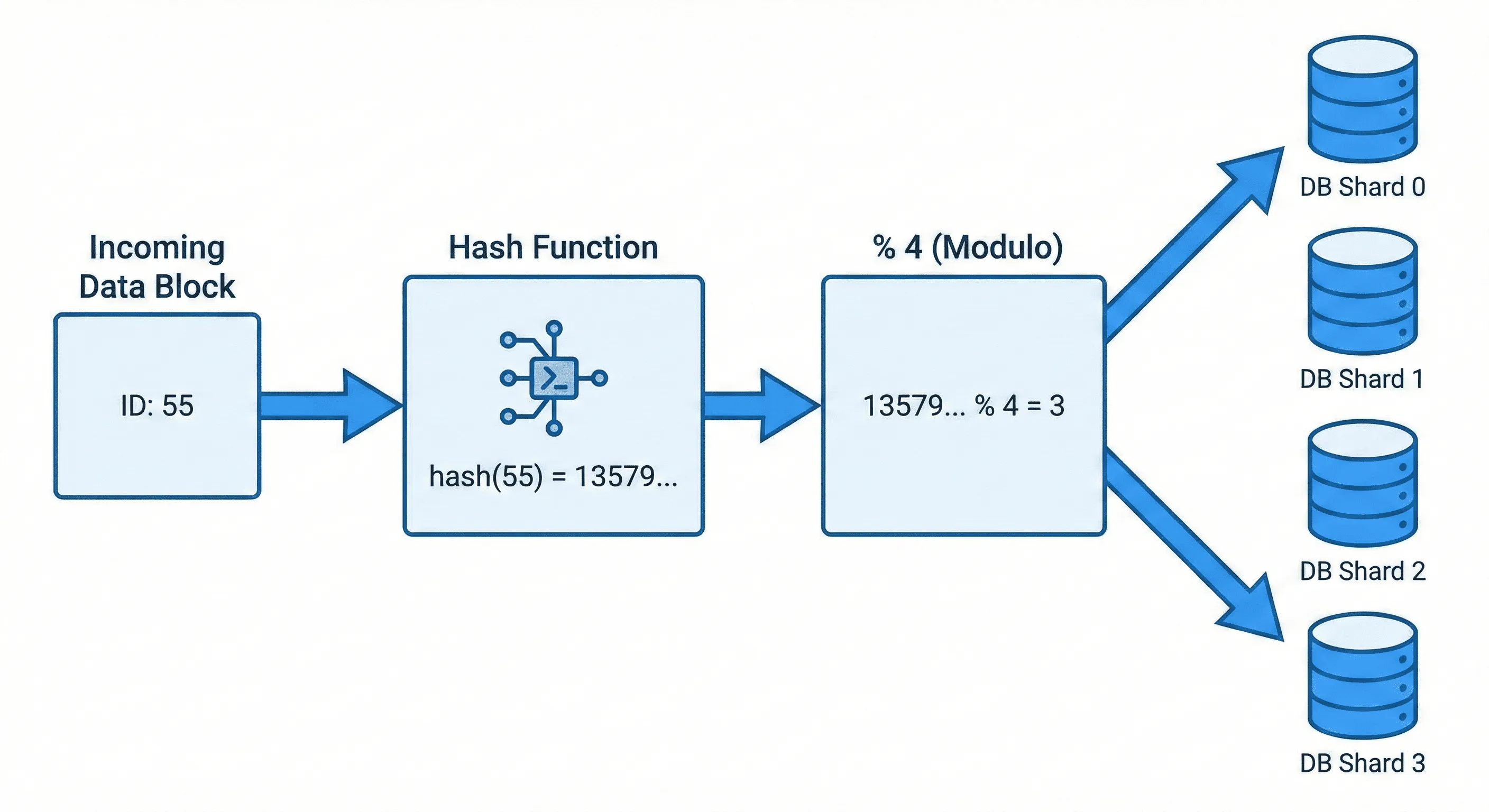
You take a value from the record (usually a unique ID like user_id), pass it through a hash function to get a numerical value, and then perform a modulo operation based on the number of shards you have.
The Formula:Shard Index = hash(sharding_key) % number_of_shards
Example:
Imagine an e-commerce site with 4 database shards, sharding on customer_id.
- Customer ID 101 tries to register.
- We hash “101” -> resulting in a large integer, say
49283. - We calculate
49283 % 4(modulo 4). The remainder is 3. - Customer 101’s data is stored on Shard #3.
Every time we need to fetch Customer 101, we run the same math and know exactly which server to hit.
- Pros: Excellent, uniform distribution of data. Prevents “hotspots” where one server works harder than others.
- Cons: Resharding is difficult. If you go from 4 shards to 5, the modulo changes, and nearly all your existing data needs to move to a different server. (Note: Consistent Hashing solves this, but adds complexity).
2. Range-Based Sharding
This is the simplest to understand. You split data based on ranges of a specific value. It’s like an encyclopedia set: Volume 1 covers A-C, Volume 2 covers D-F, etc.
Example:
A blogging platform might shard its Posts table based on the creation_date.
- Shard 1: All posts created in 2022.
- Shard 2: All posts created in 2023.
- Shard 3: All posts created in 2024.
- Pros: Very easy to implement. It is fantastic for range queries (e.g., “Find all posts from last month”) because you only have to query one shard.
- Cons: The Hotspot Problem. In the example above, Shard 3 (2024) will receive 100% of new write traffic, while Shard 1 sits mostly idle. The distribution is uneven.
3. Directory-Based (Lookup) Sharding
Instead of using an algorithm or fixed ranges, you use a separate, highly available “lookup database” that maintains a map of where data lives.
Example: A multi-tenant SaaS provider (like Salesforce or Shopify) hosts many different companies.
- The application first queries the Lookup DB: “Where does Company X’s data live?”
- Lookup DB responds: “Shard 7.”
- The application then queries Shard 7.
- Pros: Ultimate flexibility. You can move a large customer from one shard to another just by updating a single record in the lookup table.
- Cons: The lookup database becomes a single point of failure and a performance bottleneck. Every query must make an extra hop before fetching data.
The Dark Side: Trade-offs and Challenges
Sharding is not a magic bullet. It adds significant complexity to your application and infrastructure. As the famous saying goes in system design: “Don’t shard until you absolutely have to.”
Here are the major challenges you will face:
1. JOINs become near-impossible
If your Users table is on Shard A and your Orders table is on Shard B, you cannot write a standard SQL query joining them.
- The Fix: You must perform joins in the application code (make two separate calls and combine data in memory), or denormalize your data so the necessary info exists in both tables.
2. Loss of ACID Transactions Relational databases guarantee ACID compliance within a single server. If you need to update a user’s balance (Shard A) and record a transaction log (Shard B) simultaneously, the database cannot guarantee both will happen atomically.
- The Fix: You must implement complex distributed transaction protocols like “Two-Phase Commit” (2PC) or use the “Saga Pattern” (eventual consistency).
3. Operational Overhead Managing one database server is hard. Managing ten is an order of magnitude harder. Backups, monitoring, schema updates, and failovers all become significantly more complex distributed systems problems.
Conclusion
Database sharding is a powerful technique that allows applications to handle massive scale, breaking free from the constraints of a single server. By distributing data across multiple machines using smart sharding keys and strategies like hashing or ranging, you can theoretically scale infinitely.
However, the cost of this scale is extreme complexity. You lose many of the conveniences of a relational database, like easy joins and simple transactions. Before taking the leap into sharding, exhaust every other optimization avenue—caching, read replicas, and code optimization. But when you finally hit that wall, sharding is the sledgehammer you need to break through.